
Giesen Architecture is focused on creating sustainable solutions through refined simplicity in design and client collaboration.
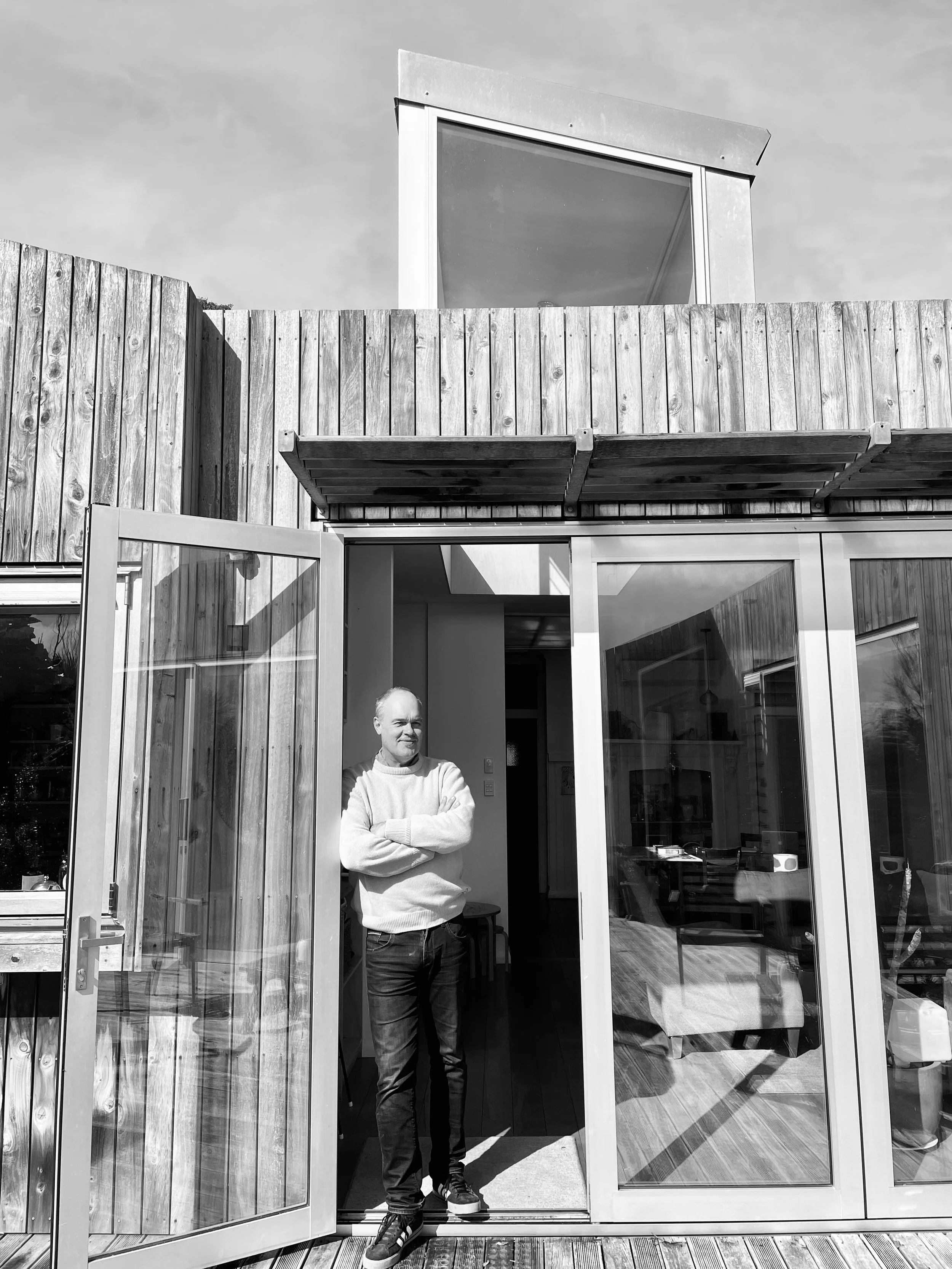
William Giesen is a sole practitioner who works with a group of skilled designers, consultants and developers . William aims to make both clients and builders integral to the the design process.
William has worked on a broad range of projects from residential, commercial, multi-residential and industrial through to educational and heritage building redevelopments throughout New Zealand Aotearoa. The redevelopment of the Old White Hart Hotel in New Plymouth is one of his most visited projects.
He divides his time between his studio in Paekakariki , on the Kapiti Coast and his Wellington office that is situated within the HMOA Architectural Practice. He collaborates with HMOA Architects to deliver larger scale commercial projects, making use of their nationwide resources and vast collective experience.
William’s work as part of Atelierworkshop / Bonnifait + Giesen (2000-2023) has won multiple architectural awards and been recognized through numerous publications, both nationally and internationally. You can see a broader range of Williams past works at ( https://www.atelierworkshop.com) . As of mid 2026 all projects featured on this website are works for which William was the Sole Registered Architect.
William is currently working on a number of housing projects around NZ. He is open to discuss projects of diverse briefs and proportions and believes his new nimble business model is well suited to meet the needs of a broad range of clients .
Bourdeaux Quays Competition Project, France 1998 - Tramway and riverside urban development.
Beginnings
In his early childhood, William’s parents hired a young, John Scott, to design a new family farmhouse in rural Hawkes Bay. Their family of five moved from their small farm cottage into a modernist, purpose-built, architecturally designed home.
“During the design process I remember a discussion about which brown to paint the roof. The house had a number separate gables. John suggested painting each gable a different shade of brown. I was amazed that this was possible. We could do anything we wanted it seemed.”
Prior to studying Architecture William Bounced around a few educational institutions . He studied politics at Canterbury University then Architectural draughting at Polytech in Auckland and Christchurch before moving to Wellington in the early 90s and eventually being accepted to Victoria University Architecture School” “ I was not sure that I was academic enough to be an architect but a close friend convinced me I could do it”
Half-way through his architectural studies at Victoria University in Wellington, William traveled to France ( at first as a Rugby player but with the intention to study ) where he was offered a place at the Bordeaux School of Architecture and Landscape design. It was here that he studied under a number of renowned French Architects including the Pritzker winning architects, Lacation & Vassal. Over this time William participated in student projects based in Casablanca and China, studying the way people lived and worked according to their environment. They called it “Anthropology of Space” . This has not been part of the NZ based studies.
This focus on design through heritage, environment and culture gave William a unique and holistic outlook, influencing his design approach.
William worked as part of a team on a number of large scale architectural and urban competitions in France, including the redesign of the Bordeaux River Front and the development of the Bordeaux Tramway system.
During his time in the Bordeaux William met Cecile Bonnifait.
William returned to New Zealand in 1999 and graduated as an Architect at Victoria University of Wellington in 2000. Cecile and he set up Atelierworkshop soon after . Later trading as Bonnifait and Giesen.